
The event brought together some 200 participants, including a strong presence of students lycées Fénelon (Paris 6ème) and Hoche (Versailles).
After a introduction from Jean Belin, Antoine Parent put the work presented into perspective, and recalled the importance of the event in relation to the Armistice centenary commemorations. Thus, the “commemorating soldiers who died for France”This is a major event, going far beyond the memorial aspect of the day's work.
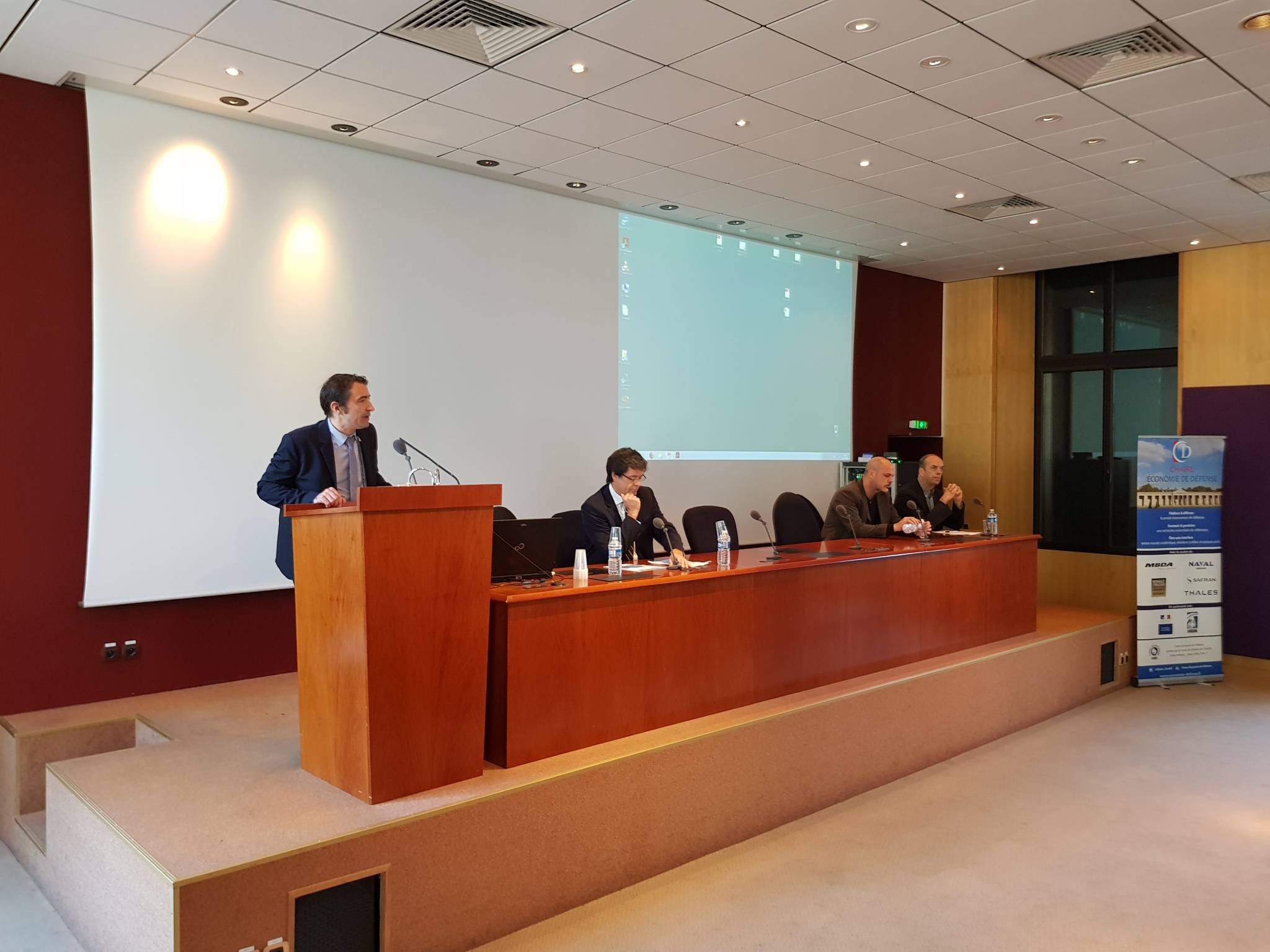

First round table
At the first round table, structured around the question of soldiers' inequalities in the face of death, Jean-Pascal Guironnet (University of Normandy, Caen) showed that there were no regions that had been sacrificed more than others from a statistical point of view. This presentation was the synthesis of a published article by the author (with Antoine Parent) in a special issue of the journal Defence and Peace Economics and coordinated by Julien Malizard, researcher at the Chaire Économie de Défense.
Olivier Guillot (BETA, Univ. de Lorraine) then proposed an analysis of the inequalities in survival times among soldiers who «Died for France», as well as the impact on these data of the number of commendations of the regiment or of those shot in its ranks. The mathematician Nicole El Karaoui (Paris Sorbonne) enriched the debate with his statistical and personal experience of these issues.

Second round table
The second round table discussed the strategic choices operated by the high command. The operational research (OR) approach of Jesus Gonzalez-Feliu (École des Mines de Saint-Étienne) has shown that certain military logistics plans followed a form of optimisation, taking into account the RO techniques of the time.
Gilles Gaba (Isfa, Univ. Lyon 1) and Stéphane Loisel (Isfa, Univ. Lyon 1) have used geomatics to study the movements of regiments at the front. Cécile Bastidon (LEAD, Univ Toulon) and Hervé Pierre (Earth Advisor to the Prime Minister) brought their economic insight and military experience to the discussion.

Third round table
Finally, the question of “those who remain” was at the heart of the third round table. Gilles Vergnon (Sciences Po Lyon) studied the violence of civil society and the return of soldiers from the front. Gilles le Garrec (Sce Po, OFCE) and Vincent Touzé (Sce Po, OFCE) then assessed the first French social policies to emerge in favour of widows, invalids and wards of the nation following the First World War.
Two testimonials then added a more personal touch: Frédéric Gannon (Univ. du Havre, OFCE) presented the biography of his great-grandfather, Georges Patard, and Pierre-Yves Péguy (LAET, Univ. Lyon 2) of his grandfather Charles Péguy, who died at the front in 1914. These works were then discussed by Isabelle Davion (Sorbonne University) and Mehrdad Vahabi (Univ. Paris 13).

